news

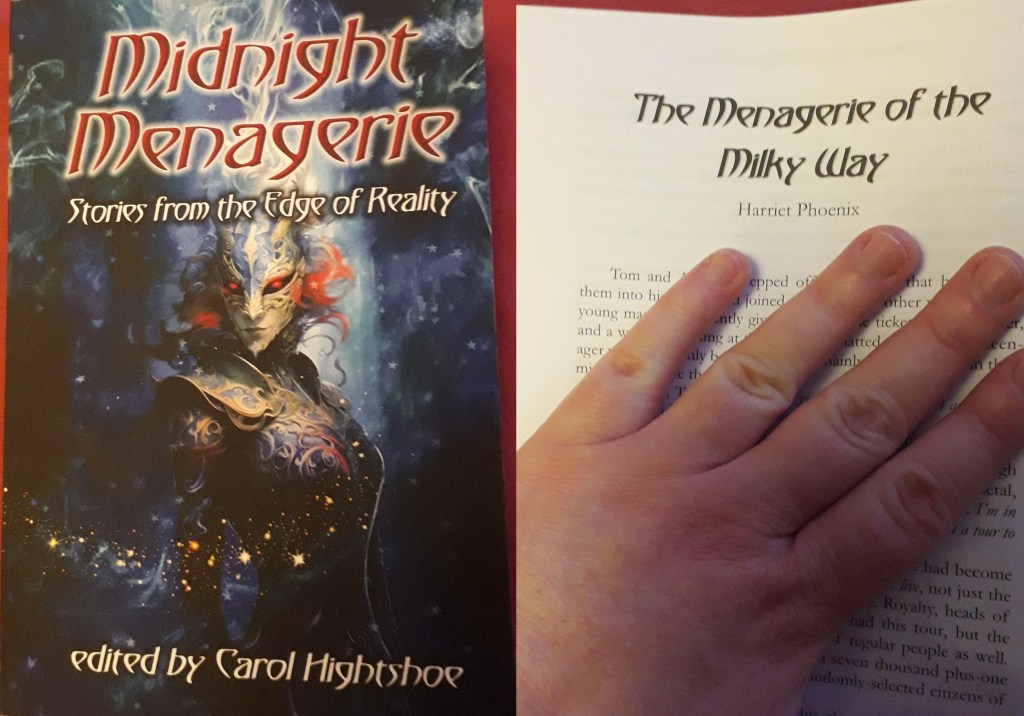
My Author Copy of Midnight Menagerie!

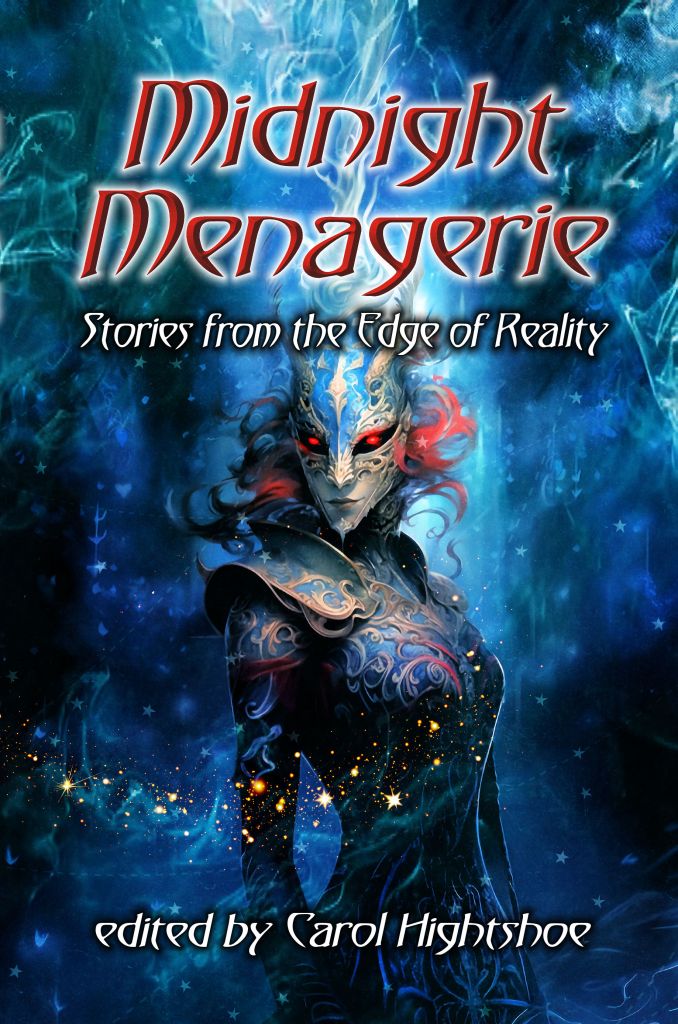
It’s been a while since I had good news to share on this site, so I’m hoping to close out the year with some joy for a change! My author copy of Midnight Menagerie by Wolf Singer Productions has arrived.

I have previously mentioned some issues that I have with this book. Well, one issue: after being accepted for this anthology, I realised that the cover was designed by AI. I of course have many, many issues with AI and especially its use in creative fields. However, I feel like I’ve covered that in my previous post, so I’d like to devote this one to just enjoying having a book out.

The stories in Midnight Menagerie explore the world of fairs, carnivals and zoos in a variety of science fiction and fantasy settings. There’s aliens. There’s goblins. There’s shapechangers, sentient clouds and a retelling of Jurassic Park where the exhibits may seem just a little familiar…

My story, The Menagerie of the Milky Way, obviously leans towards the sci-fi end of the scale and features an orbital zoo full of aliens. I had a lot of fun writing it (at least until I read out parts of it in my writer’s group and had to actually pronounce the names I’d come up with for all the alien species. Pro tip: consider these things while writing!) and I hope other people have as much fun reading it.

news

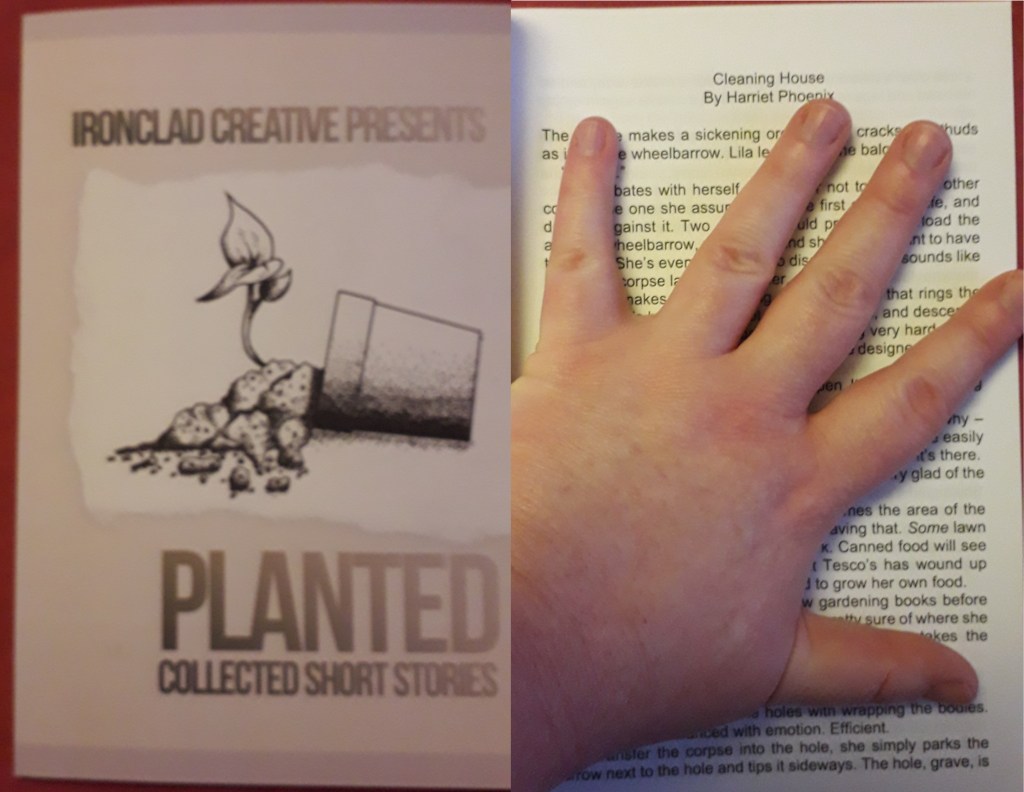
Planted is available to buy!

I’m excited to announce my inclusion in Planted, the latest anthology by Ironclad Creative! In fact, my story, Cleaning House, won 1st place! 2nd place went to Sophie Petrie with Seedling 12.0, and 3rd to Susie’s New Ears by Angelique Talbot.

Planted was a lot of fun to write, but I was surprised that it won because, well, it’s pretty dark. It does also have a hopeful undercurrent of revival, but the setting is literally postapocalyptic, so trigger warnings for extensive mention of death, including mass death.

On that cheerful note, please feel free to rush out (digitally) and buy yourself a copy! Planted is available now from Amazon to buy in Kindle or paperback.

news, Science Fiction

When Cover Art Sends You Into a Tailspin

After something of a hiatus from the world of having news, I’ve been looking forward to announcing my inclusion in the upcoming anthology from Wolf Singer Publications. I was particularly excited to receive that cover art, which is absolutely gorgeous. But something about it set off an alarm bell for me. So I checked the copyright page of the e-book, which confirmed my worst suspicions: this cover art was generated using AI.

Yeah.

So, instead of doing my usual gushy post about the new anthology I get to be a part of, and how much fun I had writing The Menagerie of the Milky Way, I ended up in a massive emotional tailspin, because I am of course ethically opposed to the use of AI in creative work. At the very least, it needs a lot more regulation than it has or seems likely to have any time soon. So. What’s a person to do?

Well, what I did is discuss the situation with a friend who shares my concerns, and then contact the editor and calmly ask her some questions. And I’m glad I did, because she was able to reassure me that the use of AI in more than pre-publication placeholder covers is not usual practice for Wolf Singer: this one came about as a writing prompt that turned into more. In other words, the anthology itself came from this image, so work wasn’t taken from a human artist. The editor also assures me that she would never use AI to copy an existing artist’s style.

That’s all nice and reassuring. There are a lot of complex issues surrounding use of AI, and people feel a lot of different ways about it. However, what I’m feeling right now is that I’ve accidentally sorta-kinda endorsed something I really don’t agree with, and that makes me pretty uncomfortable. Instead of celebrating, I’m reaching for the headache tablets.

So, where do we go from here? I guess my next step is to continue as normal, but try to pay more attention in future, I guess? (Not my strong suit)

There are still many things to be happy about. There are many, many excellent stories in Menagerie and it’s an excellent anthology. Don’t judge a book by the AI that generated its cover, right?

Midnight Menagerie is out now.

Writing Advice

Writing Advice: Finding Competitions to Enter

Once you’ve finished your story, poem, creative non-fiction or whatever variety of brain-baby you make, and you’ve made it all shiny and nice, you’ll probably want to try and publish it somewhere. Entering your work into writing competitions is a pretty good way to do this, but where do you find them? Here’s my non-comprehensive list of places to try:

Writing magazines! You ARE subscribed to at least one, right? If not, sign up to one right now (or, if budget is an issue, stop by your local library and see if they have any. If they don’t, find a librarian and ask if they’d consider signing up. And then write to your MP, governor or whoever is in charge of these things in your area about keeping libraries open). Seriously, every writer should be receiving at least one writing magazine for inspiration and information. Also, as well as running competitions themselves, any writing magazine worth reading will have a section where writing competitions and publication opportunities of all kinds are listed, often by writing form and genre. Chances are, you’ll be able to find something there that works for you.

Alternatively, there’s the standby: just Google it (using the search engine of your choice; other options are available). Plenty of literary sites list competitions, so hunt around, bookmark a few you like and check them on the regular. Throw in “writing competitions” whenever you’ve got a few minutes and see what you can find.

Of course, any publisher or other entity who have run a competition that has interested you in the past is worth checking again, even if you didn’t end up submitting or your entry didn’t make the cut. If they ran one competition that felt like your thing, chances are they’ll run another at some point, so keep a list somewhere and drop in every month or so just in case.

Obviously, once you’ve found a few competitions you like the look of you’ll want to do an organised-person thing, like make a note of it somewhere so you don’t forget and miss the deadline. I have a spreadsheet for competitions I intend to enter (for someone who doesn’t like spreadsheets very much, I do seem to have a lot of them), with columns for things like competition title, wordcount range, deadline, publisher and a hyperlink. If you’re like me and getting organised is tricky for you, then taking an hour or so to throw something like that together can save infinite headaches for Future You.

So, that’s my incomplete list of places to start your search for competitions to enter. I’ve undoubtedly missed something, but hopefully I’ve given you a few good places to start. Have fun with whatever competitions you choose to enter! Coming soon: How to Deal with Rejection!

Writing Advice

Writing Advice: Cover Letters

Another nuts-and-bolts column today. Loathe ‘em or hate ‘em, cover letters are a necessary part of submitting your writing absolutely anywhere, so hold hands and take a deep breath: let’s get this over with.

Most creative work is submitted electronically these days, so your cover letter will likely be copy-pasted into an online form, or the body text of an email with your story attached.

While the quality of your submitted work is most important, you should assume your cover letter will have a bearing on your submission’s chances; this ties back to a previous column about making life easy for whoever deals with your submission. Your cover letter is where you tell them what you’re sending and what you expect them to do with it. That might seem obvious, but imagine being the person trying to sort hundreds of incoming entries for five different competitions. They’ve probably set submission guidelines to tell you exactly which information they want from you, so read those and follow them carefully.

Your cover letter has different requirements depending on what kind of creative work you’re submitting. If it’s part of a greater project, such as an anthology or a magazine, then keep your letter short; greet the editor by name if you know it or “Dear Editor” if you don’t. In your first paragraph, tell them the name of your entry, the genre or subgenre and the wordcount. The next paragraph should be an author bio if they’ve asked for one; if not, assume they’ll ask if your piece is accepted. Then thank them for their consideration and sign off. That’s it; remember that hypothetical person with hundreds of these to go through, and don’t waste their time.

A cover letter for a novel is different. It’s an introduction to someone with whom you hope to forge an intense and prolonged business relationship; the investment of time and resources in a debut novel is immense, and the agent or publisher you’re reaching out to needs to know who they’re dealing with. Where a cover letter for a short piece needs to be to the point, this kind requires you to take your time and elaborate.

When I attended the Stockholm Writers Festival in August, I got to discuss the submission process with Liv Maidment of the Madeleine Milburn Agency, who told me a cover letter for a novel should be written “as if the person reading it will be fed up and hung over.” Going too formal is a mistake; you’re giving this person an idea of what the next few years will be like if they choose to invest in you. Don’t obscure your personality; try and cast yourself in a fun and friendly (but still professional!) light.

(It’s worth noting that I didn’t realise any of this when I was submitting my first novel and went ridiculously formal, which is maybe why no one went for that one. Maybe.)

For the same reason, don’t copy-paste this one. Personalise it. Mention why you’ve chosen this agency, this agent, in particular (“I wrote a book and you do books” isn’t it). For example, if I were to submit a work to Liv Maidment, I would definitely mention having spoken to her at a festival. If you’re a fan of one of their authors, say so, especially if you think it has a bearing on the work you’re submitting. Also; talk about your influences. Which existing authors would your work share a table display with? Pick someone well-known and recent.

So, that’s cover letters. I’ll try and do something fun next time, I promise.

news, Science Fiction

My Space Brides LLC Author Copy is Here!

It’s nice to close out the month with some good news, and luckily I have some! My author copy of Space Brides LLC has arrived! You long-time readers know how much I love this part!

Can I take a moment to enjoy a couple of things? First of all, look at that gorgeous cover. The bride in her flowing gown and that neat little bouquet, set against the backdrop of space… that is beautiful. Secondly, my story, which I had a lot of fun writing, is mentioned in the blurb. It’s a bit of a strange story that explores what marriage might mean in a society drastically different from our own, and I’m more than happy with the result. Ever want to visit a place you created in your mind?

There are plenty of other contributors besides myself, of course. I haven’t read all of them yet, but the ones I have read are brilliant. They’ve all done such different things with the concept, and results are touching, epic, funny and – of course – romantic.

Space Brides LLC is a short science fiction anthology by Wolf Singer Publications. It’s due out on December 5th, and available for pre-order as an ePub or paperback direct from the publisher, where you can use the code NR2023 to save 15%. Alternatively, find it in ePub form from Amazon, Barnes and Noble, and Smashwords. So if you have a person in your life who enjoys fun and quirky science fiction, consider grabbing them a copy for whatever upcoming holiday you prefer!

news

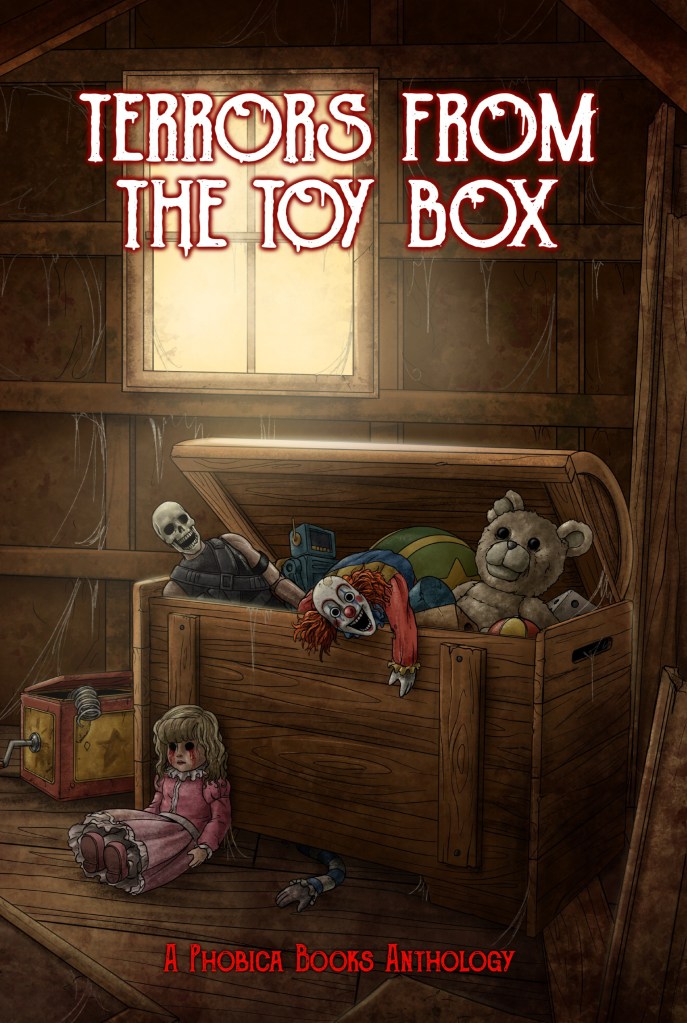
Terrors from the Toybox

I’m happy to announce my inclusion in Terrors from the Toybox, an upcoming horror anthology from Phobica Books! The anthology is due on the 1st October (in good time for Halloween!) and will be available to buy from Amazon. A great gift if you have a tradition of gifting people horror fiction for Halloween, and I’ve certainly heard of worse ideas.

Enjoy this cover art and title page illustration, courtesy of Phobica’s editing and publicity teams. I think someone had a lot of fun creating these. Seriously, how brilliantly creepy are they? Yeah, those are just old toys spilling out of a trunk… but then you see that clown. Somehow, for me the smiling clown in the attic is creepier than the jack-in-the-box below. It’s that smile. THE CLOWN KNOWS THINGS.

It’s always exciting to be accepted in an anthology. In a totally cool and professional way… someone likes my writing who isn’t my mum! They like it enough to put it in a book! Check it out: I’m on their Author Bios page!

Toy-themed horror is definitely fun to write about; specific enough to give a feel for what they want, but open enough to leave plenty of leeway. I can’t wait to see what everyone else has done with it, and I’m proud to say that my entry, ‘Enid’s Dollhouse,’ wouldn’t be out of place on Supernatural.

October can’t get here fast enough!

Writing Advice

Writing Advice: Dealing with the Competition Wait

So you’ve just entered a competition. For weeks now you’ve been lovingly tweaking and sculpting your short story, poem, screenplay, or whatever until it’s the best version of itself you can possibly manage. You’ve checked and rechecked your cover letter, made absolutely totally sure that you’re sending in the right version of your baby, and now it’s winging its way into the big wide world of literature.

So now what?

I said “competition” up there, but this applies whether you’re sending a poem to a competition, a story to a magazine or a submission package to an agent or publisher. Whichever way, it’s the same thing; for better or worse, you’ve done everything you can, your part in events is over and all you can do is wait until the judges get back to you (or, more often, until enough time has elapsed that you can assume you haven’t won). Whatever you’ve submitted to, you now have a long, agonising wait until you know if your entry has made it through. So how do you cope with the weeks of suspense?

Simple. Forget it and do the next thing.

Write another story. Find another competition. Dig out an unfinished project and see if you can revive it. Do the next thing. What you did yesterday doesn’t matter. What are you doing today?

I’m not saying forget it entirely. You’ll probably want to record somewhere what you’ve submitted, where to, and when you expect a reply. I have a spreadsheet and a separate folder for anything currently under submission. It’s good to check these things once in a while, to avoid missing the opportunity to submit that story elsewhere. I like to have a few submissions out in the world at any given time, so it’s nice to have that information available.

(Plus, I would definitely forget what’s gone to where and do something stupid, like send the same story into the same competition three years in a row, if I didn’t.)

Focusing on other projects will also distract you from the uncomfortable truth that the odds are sadly not in your favour. Fun as it is to fantasise about the respect and validation you’ll get from winning, and what you’ll do with the prize money (not that you care about such things, for you are an artist, amirite?), writing is a harsh business. The rejection rate is something like 97%. That’s not encouraging, but the alternative is never to submit anything.

The more stuff you have out there, the less each individual rejection will sting. So keep submitting, enjoy your fantasies of winning (but don’t get too invested), and above all, keep writing. The next thing ain’t happening by itself.

Writing Advice

Writing Advice: Make it Easy for Them

This time I’d like to get into some of the practical, nuts-and-bolts aspects of the writing business. Because, sad to say, writing is a business, and that means you have to deal with other people. Whenever you submit a story to a magazine or a competition, remember that you’re also sending it to a human being. A human being who probably has hundreds of submissions to go through.

Get on their good side early by making it suuuuuuper easy for them.

Start with your manuscript’s presentation. Tempting as it is to make your entry stand out with a weird font or something, at best that’s going to be annoying. At worst, your entry may be unreadable because whatever you’ve done is incompatible with their software. Avoid this by saving your creativity for the story itself and use the Schunn layout. Many submissions guidelines ask for Schunn anyway, but even if they don’t specify, you can’t go far wrong with this.

(Obviously, if a deviation from Schunn is necessary for your story, say if you’re using the text layout to create a shape and it won’t make sense otherwise, then go ahead and do that. Yes, I know, but artistic license. Otherwise…)

The only reason to deviate from Schunn is if the submission guidelines specify a different method. You DID check the submission guidelines, right? If not, go back and reread the title of this post. You’re trying to make things easy for whoever reads your entry, and the submission guidelines are where they’ve helpfully told you how to do that. If they want a particular font, use that font. If they want your entry double-spaced, double-space it. If they want your text embossed in flashing violet with sparkle effects… you get the idea. It’s their publication; they know what they want.

Competitions are often judged anonymously, so they’ll ask you to remove any identifying information from your document. If you’ve used Schunn, that means removing the name and address from the title page, as well as your name from the page headers. You’ll also want to remove your name from the document title (more on that later). The competition guidelines will often state that any entries that aren’t anonymous will be deleted. Assume they’re not kidding, and leave all your identifying information in the cover letter, which usually needs to be in the body text of an email.

Now, document titles. I think we can imagine how annoying it would be to try and find that one story you really liked out of a hundred documents all titled “Submission.” To avoid this, the guidelines will sometimes give you a specific format to follow, e.g. “[Your Name] [Story Title]” or “[Publication Title] [Story Title]”. If they specify a format, follow it. Otherwise, I usually use one of the two listed above, depending on whether judging is anonymous or not. Either way, your story title should be in the file name somewhere, just because it’s a lot easier to find that one story with dragons if you can tell, at a glance, which stories are likely to feature dragons. What are we trying to do here, folks? That’s right; make it easy for them!