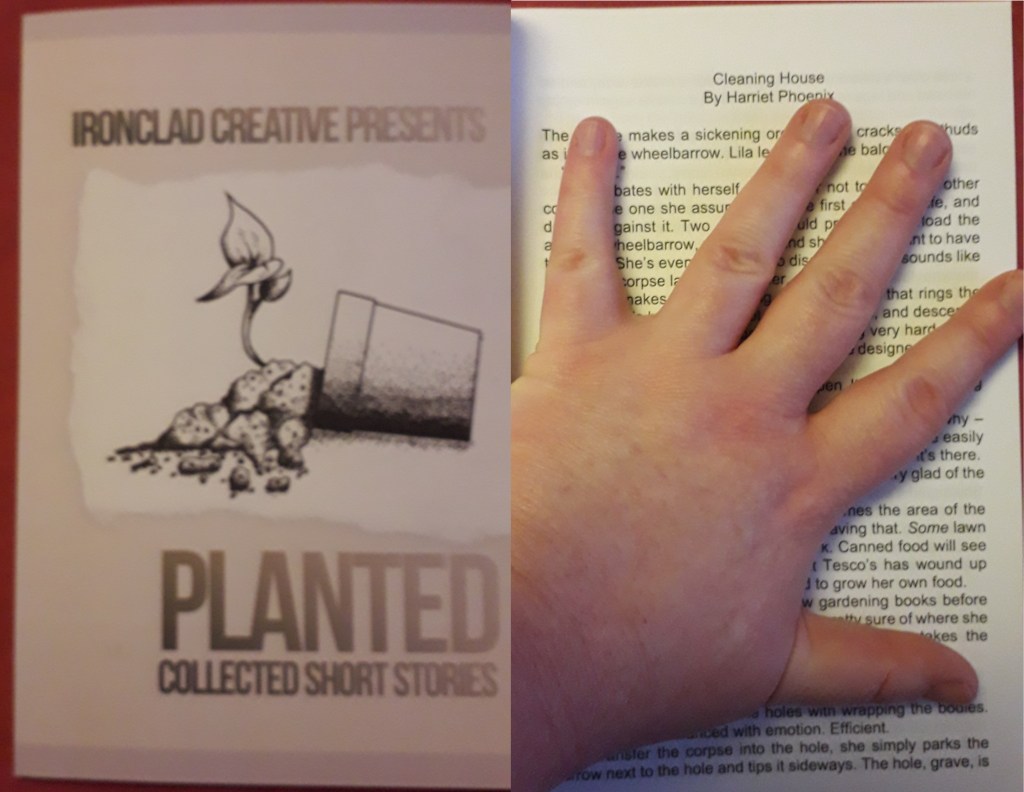
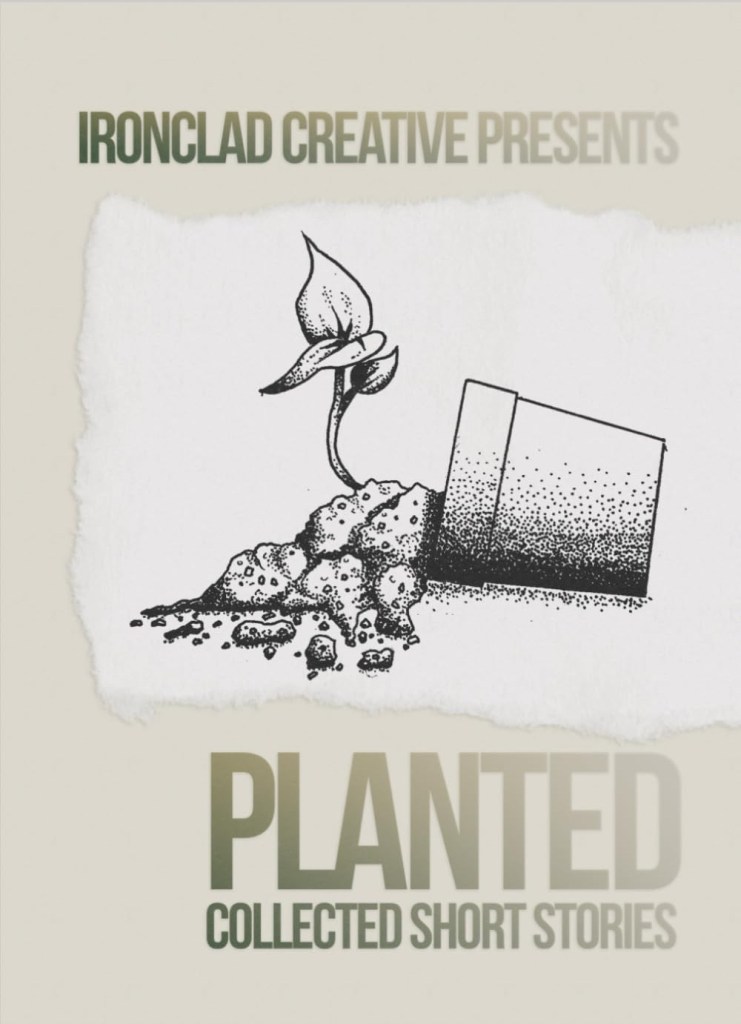
Okay, folks! One last piece of good news before we close out 2025 with its ever-increasing bevies of bewilderingly bad news. My author copy of Planted by Ironclad Creative has arrived, featuring my short story, “Cleaning House.” I don’t mean to brag (she says, lying), but mine won first place!
Fair warning: this is most definitely one of mine. Seriously, I sent this off assuming my fairly horrifying story wouldn’t be accepted by the judging panel who set such a wholesome-sounding prompt, but they totally got what I was going for and so will you! Trigger warnings include but are not limited to: references to mass death, references to a pandemic, graphic descriptions of the handling and disposal of corpses. Before I put you off entirely, yes it is on the horrifying side, and it’s bleak, but it’s also strangely heartwarming.
There are of course other stories in this anthology, and they’re brilliant. Some are bleak, some are funny, some are poignant and just about all of them hold a note of positivity… because what is planting a seed if not an act of hope for the future?
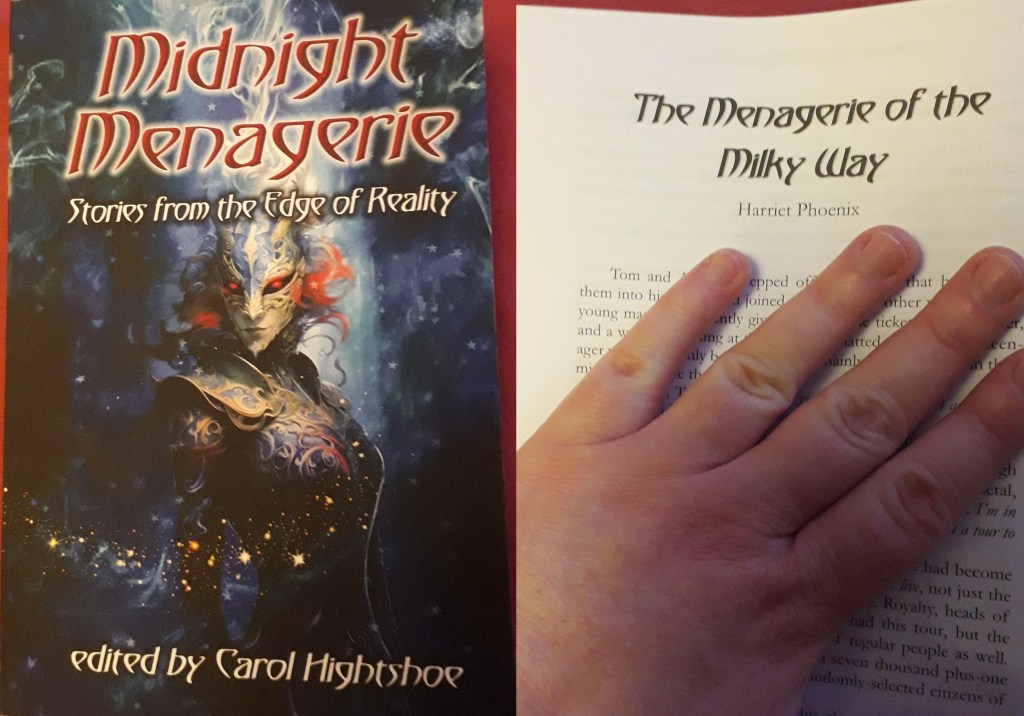
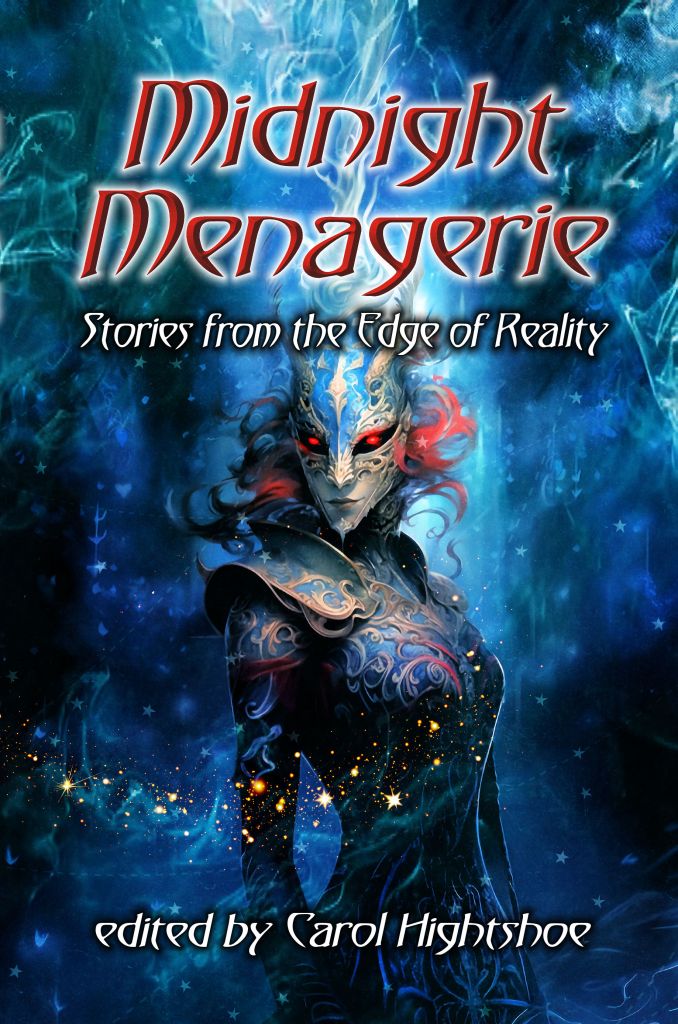
It’s been a while since I had good news to share on this site, so I’m hoping to close out the year with some joy for a change! My author copy of Midnight Menagerie by Wolf Singer Productions has arrived.
I have previously mentioned some issues that I have with this book. Well, one issue: after being accepted for this anthology, I realised that the cover was designed by AI. I of course have many, many issues with AI and especially its use in creative fields. However, I feel like I’ve covered that in my previous post, so I’d like to devote this one to just enjoying having a book out.
The stories in Midnight Menagerie explore the world of fairs, carnivals and zoos in a variety of science fiction and fantasy settings. There’s aliens. There’s goblins. There’s shapechangers, sentient clouds and a retelling of Jurassic Park where the exhibits may seem just a little familiar…
My story, The Menagerie of the Milky Way, obviously leans towards the sci-fi end of the scale and features an orbital zoo full of aliens. I had a lot of fun writing it (at least until I read out parts of it in my writer’s group and had to actually pronounce the names I’d come up with for all the alien species. Pro tip: consider these things while writing!) and I hope other people have as much fun reading it.
I’m excited to announce my inclusion in Planted, the latest anthology by Ironclad Creative! In fact, my story, Cleaning House, won 1st place! 2nd place went to Sophie Petrie with Seedling 12.0, and 3rd to Susie’s New Ears by Angelique Talbot.
Planted was a lot of fun to write, but I was surprised that it won because, well, it’s pretty dark. It does also have a hopeful undercurrent of revival, but the setting is literally postapocalyptic, so trigger warnings for extensive mention of death, including mass death.
On that cheerful note, please feel free to rush out (digitally) and buy yourself a copy! Planted is available now from Amazon to buy in Kindle or paperback.
I have not been having the very best time with technology lately. That’s not the newest thing, but when something I’ve been using with no particular problems for I-literally-can’t-remember-how-long suddenly decides I’m persona non grata, it’s hard not to take that personally.
Meta’s explanation of “Account Integrity”. As you can see, it explains everything.
The evening started like any other: doomscrolling and sharing the odd funny animal photo while chatting to a friend and browsing my many other open tabs, as you do. Only, suddenly Facebook developed a problem with me. An email, and the tab I had open to my account, informed me that my account had been suspended.
The only “explanation” I was given were two words: “account integrity.” By following that hyperlink, I got the general impression that something in my account, or something that I had shared, was deemed harmful. Facebook declined to inform me what material, exactly, this might have been.
The last post I shared was a photo of a tortoise with a baby tortoise on its head. It was adorable. In terms of understanding how I offended Facebook’s Community Standards so badly, I was precisely no better off.
I was offered the chance to appeal… at least, that’s what Facebook calls it. However, I think most of us would imagine an appeal would involve the chance to speak in one’s own defence, or at least ask a single question. “What’s the problem?” for example. Facebook has a different understanding of the concept. After requesting an appeal and proving that I wasn’t a robot, I was told that my appeal was pending.
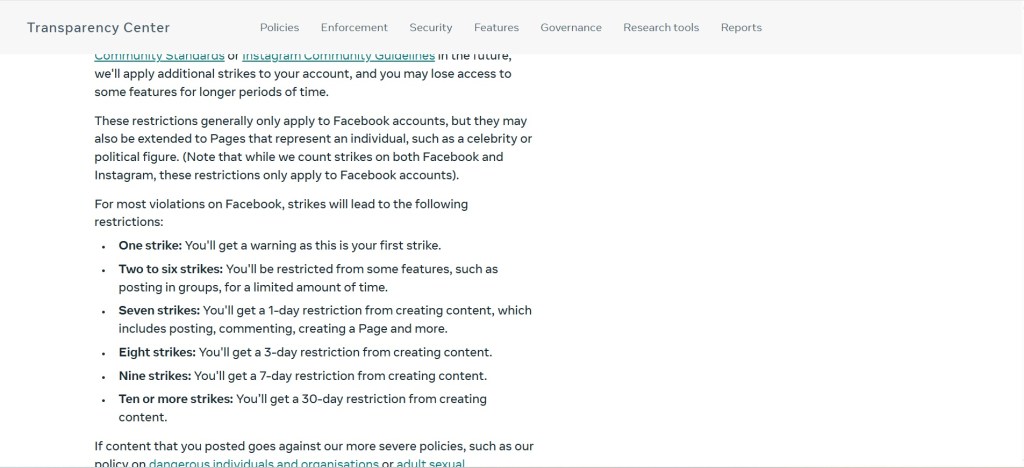
The Community Standards page. See those strikes and chances listed up there? Yeah, those didn’t happen.
So, I went about my business (more tab browsing), telling myself everything was fine. This was clearly a misunderstanding. After all, I hadn’t done anything. I wasn’t impersonating anyone else: I hadn’t posted any content that anyone but a rabid fundamentalist would consider inflammatory. I share funny animal photos and cool facts about space, for crying out loud. An overzealous bot had probably flagged a random word out of context. As soon as a human being looked at it, this whole thing would be dismissed and I’d be back in business.
An hour later, I was told that my appeal had been declined, and to kindly quit darkening Facebook’s doorstep.
That was it. No explanation of what caused this decision, no explanation of the appeals process or why my appeal was declined, just “goodbye.” I can no longer log in or access anything Facebook-related. The emails I received were from no-reply accounts. I was given an option to download my information (again, no explanation of what that means), but using that link doesn’t appear to actually result in anything downloading. The only control I can now access is the language option. If rendering the information that my account no longer exists in Urdu would be helpful, I’ve got the goods. Otherwise, nada.
Some checking around reveals that I’m far from the only person who’s experienced something like this, and there doesn’t seem to be a way forward. Plenty of people have been booted off Facebook with no idea of why, and creating another account will only result in that being deleted too. It was from these people that I got the idea that my account may have been hacked – the forbidden content may have been in an Instagram account that was linked to my Facebook without my knowledge – but, obviously, I have no way of verifying that.
Luckily, the good people of Youtube were there to help me in my hour of need! A quick search resulted in a plethora of videos explaining what to do in situations like mine. The ones I viewed gave three basic methods to access Facebook’s customer service… two of which don’t apply to me as I’m not a business, just a person trying to use my account, and the third of which only led back to the same pages that didn’t explain anything before.
The general takeaway seems to be that the Facebook era of my life is over, and I’ll probably never know why. Those running Facebook do not seem to think they owe the people using their platform anything resembling care, a fair hearing, or simply not being punished for being the victim of cybercrime.
Perhaps I’m just naïve, but in my little world, if you don’t ask for someone’s point of view, you didn’t give them an appeal. And if you can’t be bothered to tell someone why you’re mad at them, you don’t have a reason.
This all leads me to consider a question that came up more than once in my search for information. Do I, at this stage, even want my account back? Why would I want to frequent a community – online or otherwise – that treats me this way?
There’s a pretty simple answer to that. Unfortunately, it isn’t that easy. Like most people, whole swathes of my life rest upon technology, because we’ve built a world where it’s just about impossible to get anything done otherwise. And, just now, the technology on which it all rests is looking a little shaky.
Is WordPress likely to delete this website if someone leaves a rude comment? Will Youtube kick me out if it doesn’t like the lyric video I look up for a song that’s stuck in my head? Am I going to log into AO3 one day to find my account gone, and never understand why?
Don’t get me wrong: I am all for tech companies taking responsibility for the content that is posted on their platform. However, “draconian” is not the same as “better,” and “penalising the victims of hacking” is not the same as “taking responsibility.” While Facebook’s account control people pat themselves on the back for their grand victory, the actual perpetrator will shrug and go hack someone else… and Facebook will probably delete them too.
After something of a hiatus from the world of having news, I’ve been looking forward to announcing my inclusion in the upcoming anthology from Wolf Singer Publications. I was particularly excited to receive that cover art, which is absolutely gorgeous. But something about it set off an alarm bell for me. So I checked the copyright page of the e-book, which confirmed my worst suspicions: this cover art was generated using AI.
Yeah.
So, instead of doing my usual gushy post about the new anthology I get to be a part of, and how much fun I had writing The Menagerie of the Milky Way, I ended up in a massive emotional tailspin, because I am of course ethically opposed to the use of AI in creative work. At the very least, it needs a lot more regulation than it has or seems likely to have any time soon. So. What’s a person to do?
Well, what I did is discuss the situation with a friend who shares my concerns, and then contact the editor and calmly ask her some questions. And I’m glad I did, because she was able to reassure me that the use of AI in more than pre-publication placeholder covers is not usual practice for Wolf Singer: this one came about as a writing prompt that turned into more. In other words, the anthology itself came from this image, so work wasn’t taken from a human artist. The editor also assures me that she would never use AI to copy an existing artist’s style.
That’s all nice and reassuring. There are a lot of complex issues surrounding use of AI, and people feel a lot of different ways about it. However, what I’m feeling right now is that I’ve accidentally sorta-kinda endorsed something I really don’t agree with, and that makes me pretty uncomfortable. Instead of celebrating, I’m reaching for the headache tablets.
So, where do we go from here? I guess my next step is to continue as normal, but try to pay more attention in future, I guess? (Not my strong suit)
There are still many things to be happy about. There are many, many excellent stories in Menagerie and it’s an excellent anthology. Don’t judge a book by the AI that generated its cover, right?
Spell checkers are excellent things, but I think we can all agree that over-relying on them is a mistake. Like anything else, they have their limitations. The one I’m talking about today is wrong word usage.
I posted a column a while back about beta readers and why we need them. One thing I discussed in that column is that spellcheckers, for some reason, don’t always notice when you’ve used the wrong word. I used to have a weird habit of using “reign it in” instead of “rein it in,” a small but glaring malapropism that my spellchecker completely missed but my beta readers (wonderful human beings that they are) didn’t.
That’s the great thing about humans over spellcheckers; spellcheckers only know if your writing matches the rules they’re programmed with. Humans are able to think and thus realise what you meant to say and where you’ve gone wrong. We humans have our own internal spellchecker that we’ve been reprogramming every time we’ve read anything our whole lives. It’s not infallible, however, especially when it comes to our own work, which is one reason we need beta readers.
Where it gets fun is when a person’s spellchecker ends up with a bit of programming that is just plain wrong.
A girl I knew at school once got shouting angry over the word “hasty.” She was convinced it meant “slow” and was absolutely ready to die on that hill (we English nerds attract each other, alright?). We finally called over an English teacher, who thought it over and concluded that she’d misunderstood the phrase, “more speed, less haste.” Another girl was absolutely sure that magenta was a shade of blue, and smugly insisted that I, the author of a book I cited as evidence, and friggin’ Crayola were idiots for thinking it was actually pink (that girl and I were not on the kind of terms that allowed for a lot of unpacking, and so the mystery of how she came to this conclusion remains unsolved).
So, yeah. Humans can think, but our programming is as able to be wrong as a spellchecker. That’s why, as with most things, it’s best to use a variety of methods to give yourself the most opportunities to catch mistakes.
Throw words you’re not sure about into a search engine before you use them. Use your spellchecker. Use beta readers. Sneak in quick rereads at odd moments, and one last one before you his SEND just to be safe.
Finally, just accept that, no matter how many times you read your brain-baby through, or how many beta readers check it over for you, after sending it off you will find a glaring mistake that somehow got missed before, and it will be embarrassing. That’s just how it works.
My GCSE English teacher had many fun little quirks, one being that he hated semicolons with a fiery vengeance. He considered them useless articles, easily and better replaced with other forms of punctuation.
Did anyone else have this? A teacher who just sort of religiously took against a random feature of the language? He was pretty good-humoured about it, but still. That’s weird, and I’m saying that.
I, however, use them all the time. Okay, partly because I formed a habit in response to the above just to be contrary; fair comment. However, the semicolon wouldn’t exist if it didn’t serve a purpose, so let’s dive in.
A semicolon is effectively a “super-comma” used to link two complete, but closely related sentences as if they were clauses in one complex sentence, just like I did in the preceding paragraph. “… just to be contrary,” and “fair comment,” are sentences in themselves, and I used a semicolon to smush them together into one. A comma won’t work, because they only join sentence clauses, not sentences.
Basically, when a comma doesn’t feel like enough but a full stop feels too much, throw a semicolon in there and see if that works.
Now, my former teacher probably would have told me to just make them separate sentences, but I feel that a full stop would create a full-stop-level break in the rhythm that I don’t want there. Other alternatives, such as ending the first sentence and beginning the next with a connective word, like “however…” or “because…” clearly wouldn’t work there. A semicolon does.
If a semicolon is a super-comma, then the super-semicolon is… uh… a colon. Colons are mainly used to end a complete sentence and introduce something else: the basic difference between this and a semicolon is that a semicolon links two complete sentences, whereas what follows a colon is dependant on what came before to make sense. Like just there, where using the word “this” makes what comes after the colon a sentence fragment without the part before the colon. If I’d instead written, “the basic difference between a colon and a semicolon…” then that would be a complete sentence and would have to be preceded by a semicolon. Confused yet? Great!
Colons are also used to introduce a list, with the list items separated by commas (e.g. the countries of the UK are: England, Ireland, Scotland and Wales). However, where a comma is already in use the semicolon can once again step up as a super-comma to clarify things with an additional degree of separation. For example:
My favourite sci fi novels include: The Hitch Hiker’s Guide to the Galaxy, Douglas Adams; The Long Way to a Small Angry Planet, Becky Chambers; Trading in Danger, Elizabeth Moon; The Martian, Andy Weir; Earth Girl, Janet Edwards; and Leviathan’s Wake, James S.A. Corey.
(List is in no way comprehensive.)
Yes, I know; I could have used “by” instead of the commas and then commas instead of semicolons. Whatever, it’s just an example. The point is; far from being useless, the semicolon has specific uses, and gives you some flexibility in how you express yourself. It’s where the rising comma meets the falling full stop. Embrace it.
Once you’ve finished your story, poem, creative non-fiction or whatever variety of brain-baby you make, and you’ve made it all shiny and nice, you’ll probably want to try and publish it somewhere. Entering your work into writing competitions is a pretty good way to do this, but where do you find them? Here’s my non-comprehensive list of places to try:
Writing magazines! You ARE subscribed to at least one, right? If not, sign up to one right now (or, if budget is an issue, stop by your local library and see if they have any. If they don’t, find a librarian and ask if they’d consider signing up. And then write to your MP, governor or whoever is in charge of these things in your area about keeping libraries open). Seriously, every writer should be receiving at least one writing magazine for inspiration and information. Also, as well as running competitions themselves, any writing magazine worth reading will have a section where writing competitions and publication opportunities of all kinds are listed, often by writing form and genre. Chances are, you’ll be able to find something there that works for you.
Alternatively, there’s the standby: just Google it (using the search engine of your choice; other options are available). Plenty of literary sites list competitions, so hunt around, bookmark a few you like and check them on the regular. Throw in “writing competitions” whenever you’ve got a few minutes and see what you can find.
Of course, any publisher or other entity who have run a competition that has interested you in the past is worth checking again, even if you didn’t end up submitting or your entry didn’t make the cut. If they ran one competition that felt like your thing, chances are they’ll run another at some point, so keep a list somewhere and drop in every month or so just in case.
Obviously, once you’ve found a few competitions you like the look of you’ll want to do an organised-person thing, like make a note of it somewhere so you don’t forget and miss the deadline. I have a spreadsheet for competitions I intend to enter (for someone who doesn’t like spreadsheets very much, I do seem to have a lot of them), with columns for things like competition title, wordcount range, deadline, publisher and a hyperlink. If you’re like me and getting organised is tricky for you, then taking an hour or so to throw something like that together can save infinite headaches for Future You.
So, that’s my incomplete list of places to start your search for competitions to enter. I’ve undoubtedly missed something, but hopefully I’ve given you a few good places to start. Have fun with whatever competitions you choose to enter! Coming soon: How to Deal with Rejection!
Another nuts-and-bolts column today. Loathe ‘em or hate ‘em, cover letters are a necessary part of submitting your writing absolutely anywhere, so hold hands and take a deep breath: let’s get this over with.
Most creative work is submitted electronically these days, so your cover letter will likely be copy-pasted into an online form, or the body text of an email with your story attached.
While the quality of your submitted work is most important, you should assume your cover letter will have a bearing on your submission’s chances; this ties back to a previous column about making life easy for whoever deals with your submission. Your cover letter is where you tell them what you’re sending and what you expect them to do with it. That might seem obvious, but imagine being the person trying to sort hundreds of incoming entries for five different competitions. They’ve probably set submission guidelines to tell you exactly which information they want from you, so read those and follow them carefully.
Your cover letter has different requirements depending on what kind of creative work you’re submitting. If it’s part of a greater project, such as an anthology or a magazine, then keep your letter short; greet the editor by name if you know it or “Dear Editor” if you don’t. In your first paragraph, tell them the name of your entry, the genre or subgenre and the wordcount. The next paragraph should be an author bio if they’ve asked for one; if not, assume they’ll ask if your piece is accepted. Then thank them for their consideration and sign off. That’s it; remember that hypothetical person with hundreds of these to go through, and don’t waste their time.
A cover letter for a novel is different. It’s an introduction to someone with whom you hope to forge an intense and prolonged business relationship; the investment of time and resources in a debut novel is immense, and the agent or publisher you’re reaching out to needs to know who they’re dealing with. Where a cover letter for a short piece needs to be to the point, this kind requires you to take your time and elaborate.
When I attended the Stockholm Writers Festival in August, I got to discuss the submission process with Liv Maidment of the Madeleine Milburn Agency, who told me a cover letter for a novel should be written “as if the person reading it will be fed up and hung over.” Going too formal is a mistake; you’re giving this person an idea of what the next few years will be like if they choose to invest in you. Don’t obscure your personality; try and cast yourself in a fun and friendly (but still professional!) light.
(It’s worth noting that I didn’t realise any of this when I was submitting my first novel and went ridiculously formal, which is maybe why no one went for that one. Maybe.)
For the same reason, don’t copy-paste this one. Personalise it. Mention why you’ve chosen this agency, this agent, in particular (“I wrote a book and you do books” isn’t it). For example, if I were to submit a work to Liv Maidment, I would definitely mention having spoken to her at a festival. If you’re a fan of one of their authors, say so, especially if you think it has a bearing on the work you’re submitting. Also; talk about your influences. Which existing authors would your work share a table display with? Pick someone well-known and recent.
So, that’s cover letters. I’ll try and do something fun next time, I promise.
Here’s a fun fact; we don’t actually read fiction for entertainment. That’s just the lure that draws us in. But what keeps us drawn in is the chance to learn a little about those baffling mysteries of the universe: other people.
Whether it’s couched in wizards, spies or spaceship battles, a story is basically an account of how a character changes. How they overcome a flaw, or, if it’s a tragedy, how they fail to overcome it and bear the consequences. Interpreting how other people operate is one of the hardest and most important things our brains do; anything that lets us rack up a few more experience points can’t be ignored. That’s why a good story stays with us long after we’ve finished, and why cliffhangers keep us coming back; we need to know what happens, so we can add that information to the big database called “Other People: What’s Up with That?”
Of course, for that to work, your characters need to have a flaw. That’s why, whenever people complain about a book or film that “didn’t work,” it often comes back to the main character being a Mary Sue. As well as being annoying, Mary Sues have no flaw to overcome, so any story featuring one is going to turn out a little pointless no matter how many cool sword fights you throw in.
So, your character needs a flaw if we’re going to be interested in what happens to them. No decent character can be summed up in a short column, but to make a compelling personality you’ll definitely need to answer these three questions:
What’s wrong with them? How did they get like that? And how do they overcome it?
Their flaw can’t just be something you picked off a list and which has nothing to do with the story. Their flaw is the story. If we’re going to care, we need to see how it screws up their lives.
Maybe they find it impossible to form connections with anyone because they don’t trust other people. We need to see the friends they’ve driven away, the relationships they’ve ruined. We need to feel the loneliness they insist is preferable to leaving themselves vulnerable by letting other people in.
About that vulnerability… we need to understand what they’re afraid of. How did they get that way? Whose betrayal hurt them so badly? This is sometimes called a “Shard of Glass.”
Imagine your character was impaled on broken glass at some point, and a shard remained inside the wound (the betrayal). That shard continues to stab them from within (the mistrustful behaviour that damages their present relationships). Until that shard is removed, they won’t be able to heal (form rewarding relationships based on trust).
Understanding where your character’s shard of glass came from is vital for the payoff, when their emotional journey results in the conquering of that flaw.




 Harriet Phoenix