-
Writing Advice: Fanfic: Yea or Nay?

Okay, cards on the table; this column felt like a piece of harmless fun when I picked it, and now that feels like a mistake, because there are a lot of opinions out there on the subject of fanfic and whether or not it’s artistically valid or even morally acceptable.
Some of these opinions come from some very high-profile authors, such as Anne Rice, who has stated that “It upsets me terribly to even think about fan fiction with my characters,” or George R.R. Martin, who “[doesn’t] wanna read it and I would not encourage people to write it.” Diana Gabaldon colourfully expressed the desire to “barf whenever I’ve inadvertently encountered some of it involving my characters.”
Clearly, emotions run high when fanfic is under discussion.
And yet, AO3 processes 6 000 invitations per day. That’s the population of a village seeking an account from which to post or view fanfic, every day. That’s an awful lot of people for the folks mentioned above to be annoyed with.
On the other side of the fence, Neil Gaiman has stated that “all writing is useful for honing writing skills. I think you get better as a writer by writing.” Meg Cabot concurs; “I think writing fan fiction is a good way for new writers to learn to tell a story.”
Me personally – and I’d like to state for the record that this is JUST AN OPINION, DON’T SHOOT – I do find fanfiction artistically valid, although I can definitely see why others would feel differently. For one thing, I have no idea what it would be like to come across fanfic involving my own work. I imagine I’d be blown away at the idea that something I’d written had made such an impact on someone, but I don’t know that. I can also imagine wanting to avoid such works wherever possible, for the usual legal reasons and to avoid my vision getting tangled with someone else’s. But its actual existence means someone really engaged with your work, and isn’t that what we’re going for?
Finally, writing fanfic is fun. Let’s face it, writing can be tough. It’s not something anyone does because it’s easy, it’s something we do because we love it, and if you want to be able to maintain your writing then it’s important to keep touch with the fun.
I’ve made no secret lately that I’ve been struggling. Covid took a baseball bat to my immune system in the spring, I keep getting annoying little bugs and my brain keeps getting stuck on low-power mode. None of this is making it easy to keep writing, but I’ve found that if I take a break, it becomes even harder to start again. I tend to side with Gaiman and Cabot on this topic, because one way I’ve found to work with my brain is to write fanfic. It’s fun, there’s very little pressure which makes it easier, and best of all it keeps me writing.
Just, y’know, don’t expect it to advance your professional writing career or anything. I hear the copyright holders can get snippy about that sort of thing.
-
Writing Advice: Characterisation: Why Your Character Needs To Suck
Here’s a fun fact; we don’t actually read fiction for entertainment. That’s just the lure that draws us in. But what keeps us drawn in is the chance to learn a little about those baffling mysteries of the universe: other people.
Whether it’s couched in wizards, spies or spaceship battles, a story is basically an account of how a character changes. How they overcome a flaw, or, if it’s a tragedy, how they fail to overcome it and bear the consequences. Interpreting how other people operate is one of the hardest and most important things our brains do; anything that lets us rack up a few more experience points can’t be ignored. That’s why a good story stays with us long after we’ve finished, and why cliffhangers keep us coming back; we need to know what happens, so we can add that information to the big database called “Other People: What’s Up with That?”
Of course, for that to work, your characters need to have a flaw. That’s why, whenever people complain about a book or film that “didn’t work,” it often comes back to the main character being a Mary Sue. As well as being annoying, Mary Sues have no flaw to overcome, so any story featuring one is going to turn out a little pointless no matter how many cool sword fights you throw in.
So, your character needs a flaw if we’re going to be interested in what happens to them. No decent character can be summed up in a short column, but to make a compelling personality you’ll definitely need to answer these three questions:
What’s wrong with them? How did they get like that? And how do they overcome it?
Their flaw can’t just be something you picked off a list and which has nothing to do with the story. Their flaw is the story. If we’re going to care, we need to see how it screws up their lives.
Maybe they find it impossible to form connections with anyone because they don’t trust other people. We need to see the friends they’ve driven away, the relationships they’ve ruined. We need to feel the loneliness they insist is preferable to leaving themselves vulnerable by letting other people in.
About that vulnerability… we need to understand what they’re afraid of. How did they get that way? Whose betrayal hurt them so badly? This is sometimes called a “Shard of Glass.”
Imagine your character was impaled on broken glass at some point, and a shard remained inside the wound (the betrayal). That shard continues to stab them from within (the mistrustful behaviour that damages their present relationships). Until that shard is removed, they won’t be able to heal (form rewarding relationships based on trust).
Understanding where your character’s shard of glass came from is vital for the payoff, when their emotional journey results in the conquering of that flaw.
-
My Space Brides LLC Author Copy is Here!

It’s nice to close out the month with some good news, and luckily I have some! My author copy of Space Brides LLC has arrived! You long-time readers know how much I love this part!
Can I take a moment to enjoy a couple of things? First of all, look at that gorgeous cover. The bride in her flowing gown and that neat little bouquet, set against the backdrop of space… that is beautiful. Secondly, my story, which I had a lot of fun writing, is mentioned in the blurb. It’s a bit of a strange story that explores what marriage might mean in a society drastically different from our own, and I’m more than happy with the result. Ever want to visit a place you created in your mind?
There are plenty of other contributors besides myself, of course. I haven’t read all of them yet, but the ones I have read are brilliant. They’ve all done such different things with the concept, and results are touching, epic, funny and – of course – romantic.
Space Brides LLC is a short science fiction anthology by Wolf Singer Publications. It’s due out on December 5th, and available for pre-order as an ePub or paperback direct from the publisher, where you can use the code NR2023 to save 15%. Alternatively, find it in ePub form from Amazon, Barnes and Noble, and Smashwords. So if you have a person in your life who enjoys fun and quirky science fiction, consider grabbing them a copy for whatever upcoming holiday you prefer!
-
Space Brides Blurb and Cover Art!
Today I’m happy to announce that the upcoming Wolf Singer Publications anthology Space Brides is slated for a December release! I’ve seen the proofs and can now happily share with you the final cover art!

Prompts can be funny things. I’d usually be put off by a prompt as specific as this one, but somehow the idea of a matchmaking agency that serves a spacefaring humanity as it spreads through the solar system worked for me. It sent my brain to a fairly weird place as I tried to imagine the ways marriage might evolve in such a setting. I had a lot of fun writing my entry, Runaway Bride, and I’m so happy it was accepted.
If a diverse cast of science fiction characters finding love in strange new places sounds like something you ‘d be interested in, then please keep an eye on this site! I’ll be posting updates as I get them.
-
Writing Advice: What You Think You Wrote vs. What You Actually Wrote: Why You Need Beta Readers
It’s a common question among new writers: do I really need to get a second opinion on my writing before I submit it anywhere?
Yes. Yes you do.
Even if you’re a professional proofreader or editor, you still need someone else to glance over your baby to tell you what is and isn’t working. Maybe you love that comedy character… but he adds nothing to the plot and yanks the reader out of the story. This passage might be some of your best writing… but it jars with the rest and screws up the theme of your story. That fountain you described in loving detail is a colourful piece of scene-setting… but the way you brought it up implies someone’s getting pushed in, which leaves your readers feeling cheated when no one does. You probably won’t spot these things. You need people to tell you.
I recently finished a short story for a competition and sent it off to a couple of University friends for their opinions. They both liked it, but one had questions about a particular object the main character obtained partway through; what happened to it?
Now, I was perfectly clear on when and how the object gets lost. Somehow, though, that information wandered off between my brain and my fingers and didn’t make it onto the page. Like the object in the story, it just sort of disappeared.
Beta readers are also the perfect person to tell you about shortcomings in your own writing that might not be obvious to you because you’re the one who wrote it. Most writers habitually do some niggling thing, like overusing a particular word (for me it’s “little”). Then there are more general mistakes, like typing errors resulting in a different, wrong word that you’re spellcheck doesn’t pick up but your readers probably will.
Things like that can become distracting for a reader, make your work seem sloppy, and potentially be the One Thing that makes an editor choose a different story. That’s why you really need someone to spot them for you.
(Incidentally, did you see what I did there? My spellchecker didn’t. The trouble with spellcheckers is that I’m pretty sure they’re programmed by computer nerds, not English nerds. Just know that it physically pains me to leave that in there.)
You know your story (hopefully) inside and out. You know why that person’s upset with your character and why that bracelet’s important. And that’s great, but it’s also the problem; you know exactly what you intended to write, and that can make you miss what you actually did write.
Good beta readers can improve things in ways you flat-out didn’t see coming. I recently shared a few chapters of a fanfic with a friend. The feedback I got was mostly positive, but the best thing was a prediction she made which was… not at all what I was going for. The way I’d written something foreshadowed things I hadn’t intended.
Here’s the thing, though; her prediction was better than what I’d planned. Much better. My original plan would’ve foreshadowed things that didn’t happen, and been pretty dull in comparison. Instead I ended up rewriting a couple of upcoming chapters I’d half-written, and it was great. All thanks to beta reading.
A beta reader goes into a story with no idea what you were trying to do, which makes them the perfect person to tell you without preconceptions what does and does not come across. You are literally the only person in the world who can’t do this.
-
A Review of Terrors from the Toybox!
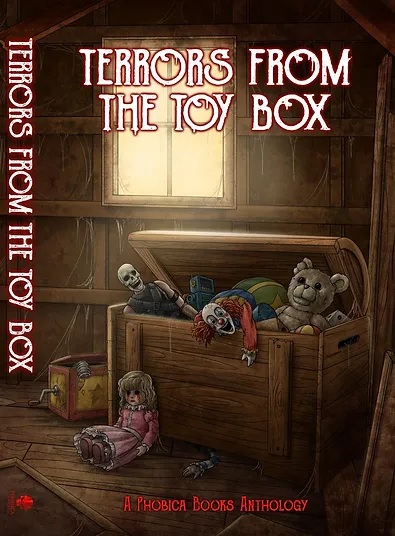
Phobica Books have posted on their Facebook page that a review on Terrors from the Toybox has been posted by Alpha’s Court! Check it out here.
Just looking at their main page, it looks like Alpha’s Court really know their horror. That’s why I’m so flattered to have an entire paragraph of their review devoted to ‘Enid’s Dollhouse’ and how “absolutely terrifying” it is! Three of Toybox‘s authors have been given a spotlight and I’m thrilled to be one of them.
I horrified someone! I’m so proud!
-
My Terrors from the Toybox Author Copy is Here!

It’s that time again… the part of an anthology’s publication when I get to hold a copy of the book in my actual hands! That’s right: Terrors from the Toybox is now available in both Kindle and paperback formats, and my author copy has arrived!
I think I’ve mentioned before that there’s no feeling quite like this. My brain-baby is out there, on actual pages that, just maybe, someone is reading right now!
Yes, I’ve done this before. But it just never gets old!
I’ve been reading some of the other stories in Terrors, and I can say without (too much) vanity that there is some brilliant writing in here. So, if you’re looking for some short fiction to get you in the Halloween spirit, consider giving this one a try!
-
Writing Advice: Shut Up and Write the Damn Thing: Inner Cheerleader
Much of my writing advice falls under the umbrella of “shut up and write the damn thing,” so this entry will probably develop a few sequels in the future. For now, though, I’m talking about first drafts.
They will suck. They’re meant to. Accept that and write them so you can move on.
This is a trap quite a few writers, myself included, have fallen into; hmming and hahing over your first draft, trying to make it perfect when all it needs to be at this stage is done. You can spend hours agonising over…
.. Wait. Should I have used “agonising” there? Bit cliched, isn’t it? Should I say “obsessing” instead? Eh, that seems a bit flat. What about “vacillating”? Wait, do enough people know what “vacillating” means? Do I know what it means? Maybe I should look it up…
Don’t. Put the nearest word you can think of, and trust that Future You will notice if it’s wrong.
Trusting Future You is a big part of getting your first draft done. But you can do that, right? I mean, they’re you. The only difference is, they’ve done slightly more writing than you have and they’re slightly better at it.
I do keep having problems with this, because whatever I’m writing tends to percolate in my brain for a while before making it outside. This means I’m often transcribing whole passages that arrive fully-formed after bubbling away in my subconscious, so when I reach a part that isn’t already formed and that I have to compose using my actual waking brain, it can feel like rushing headlong into mental quicksand. But I’ve found over time that squirming free of that quicksand can be as simple as remembering one thing:
If you have something, you can make it better. If you don’t, you can’t.
What you need to do at the first draft stage is send your Inner Critic home for the day. His time will come. For now, you need your Inner Cheerleader. Train up the voice in your head that celebrates the act of simply making progress.
“You wrote a thousand words today? Well done you! Hey, you know what? I bet you could do it again. Then you’re ahead on tomorrow, right? Hey, you did it! You’re a star! Think you can do just a couple hundred more?”
(Important note: you may be ahead on tomorrow, but when you actually get there that word counter resets to zero. Your Inner Cheerleader’s job is to keep you writing.)
Now, doesn’t that seem a little more productive than all that obsessing (worrying? Brooding?) over a single word back there?
The point is to forget the pressure of making it good in favour of getting it done. So train that cheerleader voice, trust your future self, and remember, you’ll make it better later.
Above all, just shut up and write the damn thing.
-
Terrors from the Toybox
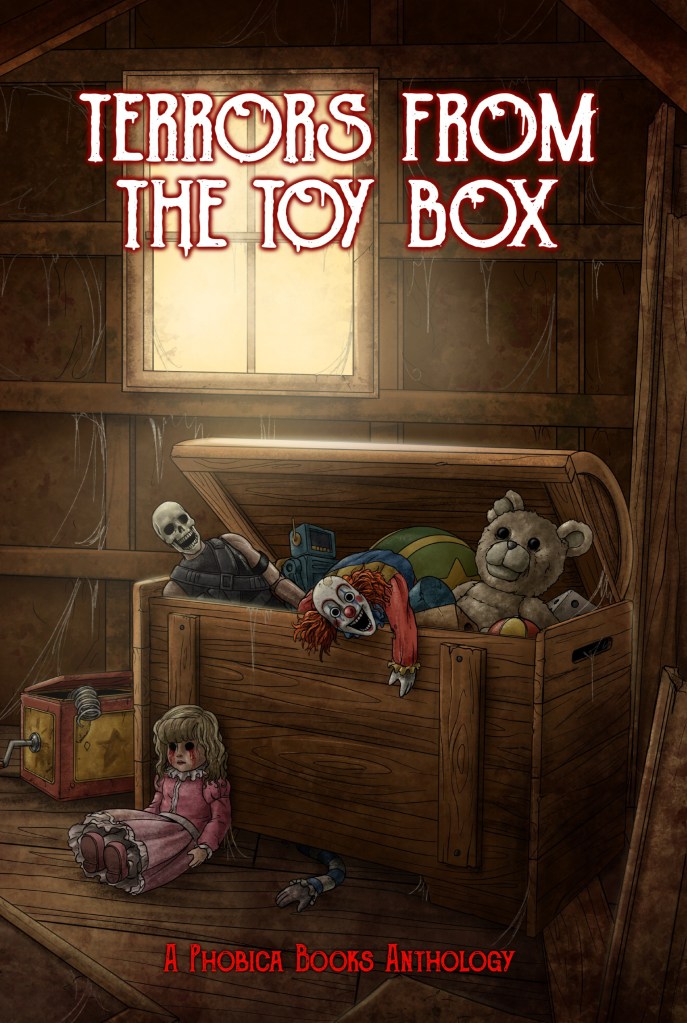
I’m happy to announce my inclusion in Terrors from the Toybox, an upcoming horror anthology from Phobica Books! The anthology is due on the 1st October (in good time for Halloween!) and will be available to buy from Amazon. A great gift if you have a tradition of gifting people horror fiction for Halloween, and I’ve certainly heard of worse ideas.
Enjoy this cover art and title page illustration, courtesy of Phobica’s editing and publicity teams. I think someone had a lot of fun creating these. Seriously, how brilliantly creepy are they? Yeah, those are just old toys spilling out of a trunk… but then you see that clown. Somehow, for me the smiling clown in the attic is creepier than the jack-in-the-box below. It’s that smile. THE CLOWN KNOWS THINGS.

It’s always exciting to be accepted in an anthology. In a totally cool and professional way… someone likes my writing who isn’t my mum! They like it enough to put it in a book! Check it out: I’m on their Author Bios page!
Toy-themed horror is definitely fun to write about; specific enough to give a feel for what they want, but open enough to leave plenty of leeway. I can’t wait to see what everyone else has done with it, and I’m proud to say that my entry, ‘Enid’s Dollhouse,’ wouldn’t be out of place on Supernatural.
October can’t get here fast enough!
-
Stockholm Writers Festival 2023
Another month over and guess what! I have some actual news! This month I went to Stockholm to attend the Stockholm Writers Festival. If you’re a writer, and you don’t do writer events, then I strongly recommend giving them a try (and if you do, you can do a lot worse than going to Stockholm).
Seriously, the SWF was founded because Stockholm-based writers were sick of having to travel abroad to attend literary festivals, yet writers flew in from as far away as Texas, and I was not the only Brit.
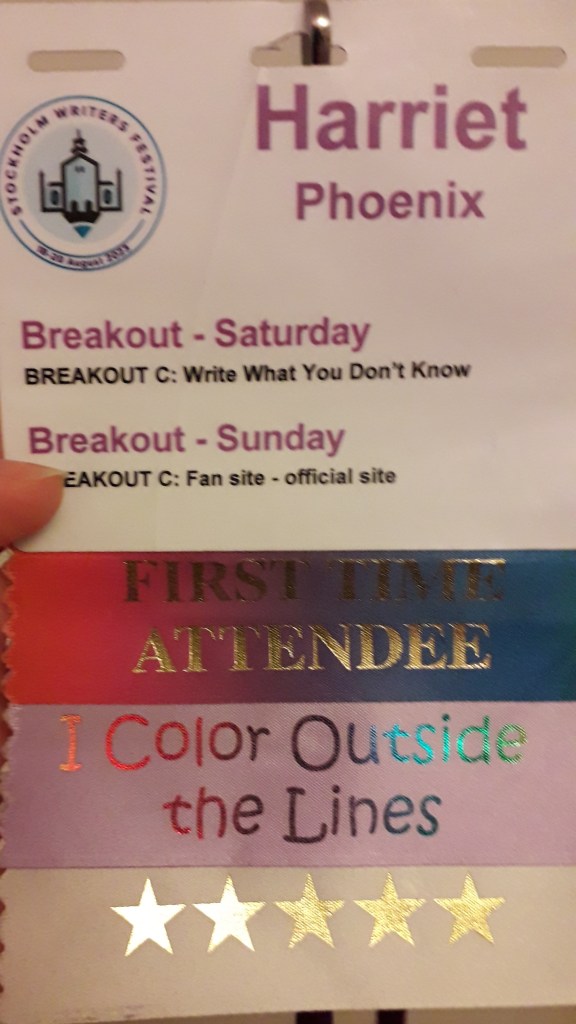
We were encouraged to add shiny things to our badges Guest speakers included literary change agent and author advocate April Eberhardt, Golnaz Hashemzadeh Bonde, author of What We Owe, American authors Johnny Shaw (whose ‘Write what you Don’t Know’ seminar I attended) and Jeff Bens, Liv Maidment from the Madeleine Milburn Literary, TV & Film Agency and Stephen King aficionado Hans-Åke Lilja. So that’s a pretty varied roster of people, not to mention other industry experts who popped up throughout the weekend.
If you do attend events like this, then I won’t need to tell you about what I’m calling the Writer Critical Mass Effect. For everyone else, what happens is that you get a large number of writers together who are suddenly aware that, hey, we don’t have to pretend to be normal! Everyone here is just as strange as I am! Everyone else’s search history is just as worrying as mine!
A hundred or so people who are usually somewhat isolated all start vibing together about the thing that typically isolates them, and a strange energy starts to build. I do attend a local writer’s group, so I was definitely aware that hanging with other writers and getting to relax a little is fun. But this was a much larger, more diverse group of people than I was used to, and I learned that enough writers vibing together with a high enough level of excitement form a sort of hive mind. Strange but true. Seriously, fellow writer-folks, find yourself an event and try it for yourself.

British fantasy & science fiction author
 Harriet Phoenix