Writing Advice

Writing Advice: When You Really Do Have to Stop for A While

Thought I’d update the photo. Enjoy!

Most writers will tell you – and it’s true, today’s column notwithstanding – that you can’t accept excuses from yourself not to write. Writing is not something you do “as inspiration strikes,” it’s a habit you must cultivate. You must keep showing up, even when you don’t really want to, if you intend on making any serious headway. If you want to actually be good at writing.

All of that is true. However, there are also times when you really do have to take a break.

This winter and spring, I was on a decent creative roll. Then in April, after dodging the bullet for three years, I got hit with Covid.

Now, reactions to Covid fall across a very wide spectrum from “didn’t notice” all the way up to “died.” Mine was about in the middle. I wasn’t in any serious danger, but basically everything I was doing besides “being sick” came to an abrupt halt.

Imagine riding a bike downhill. It’s so easy you don’t even have to pedal; you just freewheel it. Your feet aren’t touching the pedals, the wind is in your hair and you feel amazing. But then, something happens. Some arsehole throws a stick into your bike wheel and you go over the handlebars. You’re upside down on the pavement with a bike lodged in your thorax, most definitely not riding.

During those couple of weeks, my energy budget was slashed to the bone. Lying around watching Pixars from a sofa nest was in the budget. Calling 111 and chatting to the nice doctor about paracetamol and throat sprays was in the budget. Writing? Not so much. So I decided to save my energy for getting better, and officially put the writing on hold.

But the story doesn’t end when my symptoms cleared up. Because after Covid, there was good ol’ Long Covid Brain Fog. It makes sense; the brain is an energy-hungry organ, and Covid is an energy-draining illness. It does make sense that a bout of Covid would put your brain on energy-saving mode for a while, and that non-vital applications like “making shit up and then prettying it for others to enjoy” would be suspended for a while.

Seriously, when I think back to how I felt in January to March, it’s like I was flying. And I can’t remember how I got up there, but I need to figure it out, because I know a big part of the problem is that I did, in fact, stop. Whatever the reasons, I made that decision, and now nudging my brain into working properly again is up to me. I’m doing that by signing up to every writing competition I can find that’s remotely applicable to me and challenging myself to write something for each of them no matter how uninspired I feel. I think it’s working; I’ll keep you posted.

So I guess the takeaway is that, however committed a writer you are, there will come a time when you do have to take a break. But in taking that break, you need to be aware of the other side of the coin; recultivating the habit. Accept from the start that at some point, you will have to extract that bike from your midriff, peel yourself off the pavement and get riding again.

Writing Advice

Writing Advice: She Said, Adverbedly

I feel like, if you give writing advice, somewhere you have to mention adverbs. It’s like a requirement, you know?

I had no idea how controversial adverbs were until University. One of my tutors had posted a helpful grammar guide that I now wish I’d control+C’d and saved somewhere. For one thing, I’d be able to quote directly the part that went something like, “Now, I know you’ve all been told in school to never, ever even think of using an adverb…”

This is where I looked very confused, because I had heard no such thing.

To be fair, I moved around a lot as a kid, so maybe I just missed the ‘ADVERBS: DO NOT’ talk every time, but I’m pretty sure they were introduced as just another kind of word. I’m sure there are people who will absolutely die on the Adverb Hill, but I’m pretty sure that to most people, adverbs are fine as long as you only use them as they should be used, and that sparingly.

A verb is a word for an action. An adverb is a word that describes the action. Thus, in the sentence, “She slept soundly,” “slept” is the verb while “soundly” is the adverb.

An adjective describes a noun. An adverb modifies an adjective. Thus, in the sentence, “The biscuit was somewhat stale,” “stale” is the adjective while “somewhat” is the adverb.

An adverb can also modify another adverb. Thus, in the sentence, “He checked his answers very thoroughly,” both “very” and “thoroughly” are adverbs.

Clearly, adverbs exist for a reason. However, Stephen King said, “The road to Hell is paved with adverbs,” Anton Chekhov advised writers to “cross out as many […] adverbs as you can,” and Mark Twain declared himself “dead to adverbs.” We can probably assume those folks know/ knew a thing or two about writing, so what’s the problem?

The main issue people have with adverbs is that they can usually be cut out altogether by trading in the word you’re modifying. For example, “He walked quickly” can become “He hurried,” “He hustled,” “He fled,” etc. Notice how these are not only quicker to read, they’re also more interesting and, sometimes, give an idea of what’s happening. Similarly, “The light was very bright” becomes “The light was blinding.” Even in the adverb-on-adverb example above, “very thoroughly” could be “meticulously” or “obsessively.”

Brilliant as this may be when you’re making cuts to fit that wordcount you’re already pushing, it does have the effect of rendering the adverb as, “that thing you do when you can’t think of a better verb.” This does not add to its perceived coolness.

It doesn’t help when people misuse adverbs by throwing them in where they don’t add anything. Don’t say, “She laughed happily,” because laughs are usually happy; the fact of laughter makes us assume happiness. Adverbs should tell us something we wouldn’t assume from the word being used. Go ahead and tell us she laughed “bitterly,” “sarcastically,” or even “nastily,” though. That’s new information; it challenges the assumption we made when you told us she was laughing.

The bottom line is this; as a writer, every word you use needs to be there for a reason. If deleting your adverb doesn’t change the meaning of a sentence, it’s clearly not earning its place and needs to go.

So that’s adverbs done. Phew. I’ll do something fun next time, I promise.

Writing Advice

Writing Advice: Make it Easy for Them

This time I’d like to get into some of the practical, nuts-and-bolts aspects of the writing business. Because, sad to say, writing is a business, and that means you have to deal with other people. Whenever you submit a story to a magazine or a competition, remember that you’re also sending it to a human being. A human being who probably has hundreds of submissions to go through.

Get on their good side early by making it suuuuuuper easy for them.

Start with your manuscript’s presentation. Tempting as it is to make your entry stand out with a weird font or something, at best that’s going to be annoying. At worst, your entry may be unreadable because whatever you’ve done is incompatible with their software. Avoid this by saving your creativity for the story itself and use the Schunn layout. Many submissions guidelines ask for Schunn anyway, but even if they don’t specify, you can’t go far wrong with this.

(Obviously, if a deviation from Schunn is necessary for your story, say if you’re using the text layout to create a shape and it won’t make sense otherwise, then go ahead and do that. Yes, I know, but artistic license. Otherwise…)

The only reason to deviate from Schunn is if the submission guidelines specify a different method. You DID check the submission guidelines, right? If not, go back and reread the title of this post. You’re trying to make things easy for whoever reads your entry, and the submission guidelines are where they’ve helpfully told you how to do that. If they want a particular font, use that font. If they want your entry double-spaced, double-space it. If they want your text embossed in flashing violet with sparkle effects… you get the idea. It’s their publication; they know what they want.

Competitions are often judged anonymously, so they’ll ask you to remove any identifying information from your document. If you’ve used Schunn, that means removing the name and address from the title page, as well as your name from the page headers. You’ll also want to remove your name from the document title (more on that later). The competition guidelines will often state that any entries that aren’t anonymous will be deleted. Assume they’re not kidding, and leave all your identifying information in the cover letter, which usually needs to be in the body text of an email.

Now, document titles. I think we can imagine how annoying it would be to try and find that one story you really liked out of a hundred documents all titled “Submission.” To avoid this, the guidelines will sometimes give you a specific format to follow, e.g. “[Your Name] [Story Title]” or “[Publication Title] [Story Title]”. If they specify a format, follow it. Otherwise, I usually use one of the two listed above, depending on whether judging is anonymous or not. Either way, your story title should be in the file name somewhere, just because it’s a lot easier to find that one story with dragons if you can tell, at a glance, which stories are likely to feature dragons. What are we trying to do here, folks? That’s right; make it easy for them!

Writing Advice

Writing Advice: Throw the Pointy Rock

After talking last time about respecting the writing community, now I think it’s time to get into some advice about actually writing! I’d like to focus on plotting, as in, deciding what actually happens in your story.

Say you have a story, and you’re not sure where to go with it. Then, out of nowhere, a plot development occurs to you. It’s perfect: it touches themically on everything that’s gone before while upping the stakes to dizzying new heights. It’s also cruel, horrifying and will utterly destroy your poor dear character.

“Oh, no!” you think. “I can’t possibly do that!”

DO IT.

Let’s face it, it’s already done. If you have such a strong emotional reaction to your idea, then that idea is the only thing that can happen. It means that you just touched the third rail that gives your story life. If your character’s journey doesn’t affect you, why should anyone else care?

Director and playwright George Abbot said that your job as a writer is to chase your character up a tree and throw rocks at them (and yes, I did have to look up where that quote is from). That “I can’t possibly!” reaction means that you just picked up a big, pointy rock that is really going to hurt when you hurl it into their face. But that’s what we’re here for, and that’s why you have to go ahead and throw it, sweetie, as hard as you can.

Plot is what happens. Story is why it happens, and what happens because of it. Stories are about change, and changes don’t happen for no reason. People don’t change for no reason. They change because something forces them to change; something painful and, above all, personal. That development you just dreamed up is daunting because it hits your character right where they live; their worst nightmare, their secret shame, their deepest trauma. And that’s where the stakes are.

If anyone’s going to care what happens in your story, then it has to hurt.

After all, why did you give your character a deepest nightmare, if you’re not using it to torture them?

Writing Advice

Writing Advice: Feed the Good Wolf

So I’ve been thinking about what to do with this blog other than post my fairly scant news, and I’ve decided to try sharing my random insights on writing. Maybe this will be of use to someone who’s struggled with the same things I have, or maybe someone will just get a good laugh out of it. Who knows? We’ll see what happens.

I’m hoping to cover something from all aspects of writing, from the creative process itself to the nuts-and-bolts aspects of getting published, but for this first post I’d like to focus on how you, as a writer, interact with the greater writing community. I’m calling it, “Feed the Good Wolf,” but it could just as easily be, “Listen to the Shoulder Angel,” or, “Seriously, Don’t be a Dick.”

A few years ago, I was working at an academic publisher. There was a writer’s group there, and it was from this group that I heard about a writing competition. I forget exactly who was running it, but they were putting together an anthology aimed at new writers. That’s right: PUBLICATION was on the table here. Cue heavenly choir.

I was not yet published. Not even a little. Did I want in on this anthology? Hell. Yeah.

As I was preparing my entry, it suddenly occurred to me that other people might want to hear about this competition as well. I thought it might be nice to send a link to my old University, so the latest batch of Creative Writing students might get in on the action too. If I sent my old tutors a link, maybe someone could print off a poster and all those fresh-faced under- and post- grads could send in their entries. I felt really good about this idea!

Until the ol’ shoulder devil started talking. “Hold on there,” it said. “That sounds like an awful lot of extra competition you’re courting there. You sure you want to do that?”

I HAD been sure… until then. But the more I mulled it over, the more it seemed like a mistake. How would I feel if I shared this competition, and then lost? Like a sucker, that’s how. I’d been tremendously lucky to hear about this competition; was I obliged to share that luck? I decided I wasn’t. I’m not proud of it, but that’s what happened. I listened to the shoulder devil, fed the bad wolf, and generally acted like a selfish, insecure ass. I sent my entry off and sat back, proud of what a pragmatic, cut-throat decision I’d made.

The competition was cancelled due to lack of entries.

Yeah. Score one for cut-throat pragmatism.

 Now, I don’t know if sharing that link would have changed anything. Maybe there still wouldn’t have been enough entries of sufficiently high quality. Maybe the competition would have gone ahead, my story wouldn’t have won and I’d have been angry with myself for a different reason. Or maybe the anthology would have happened and I’d be in it, pleased with myself for taking the high road.

I hear from time to time that society works better when people are altruistic, because the fewer people act like selfish asses, the more nice things we’re able to have. In this case, a potentially great thing didn’t happen, that I might have been able to save but didn’t, because I was too busy watching my own interests.

Look, I can’t tell you to share a great opportunity rather than hoard it. All I can tell you is that if you’re a writer, then the writing community’s interests are your interests. Do you want to live in a community of good wolves, or bad ones? That’s up to you.

fantasy

An Author Copy and an Honourable Mention

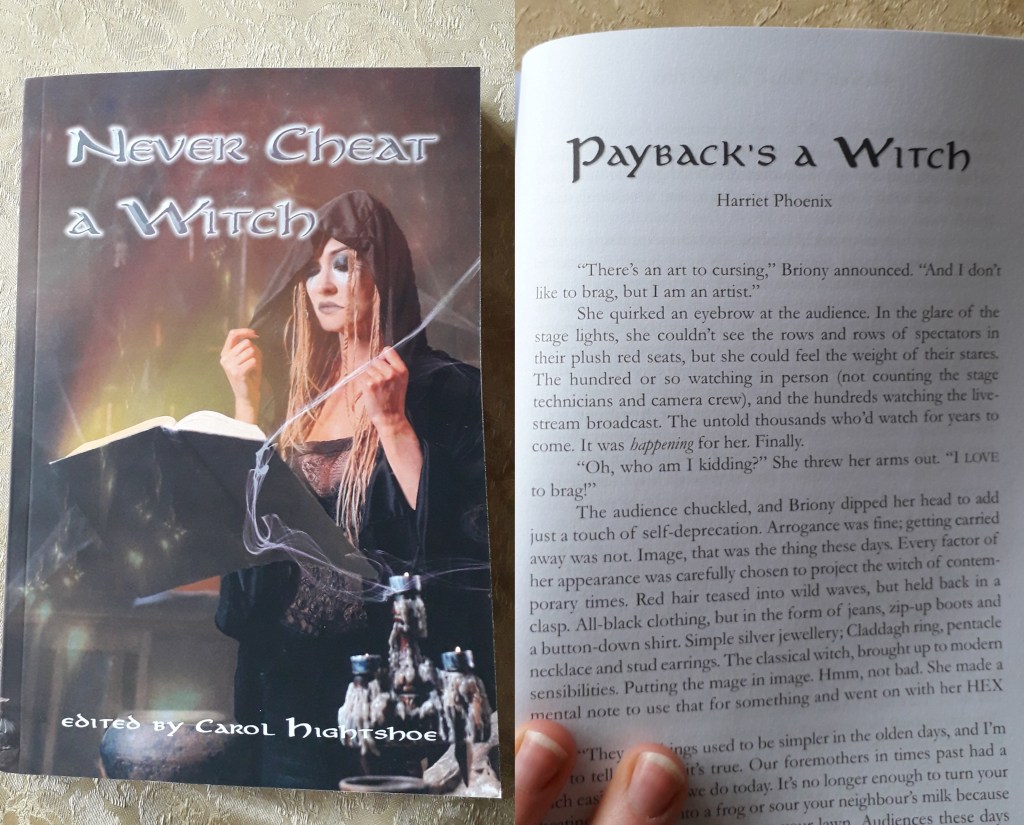
Guess what, guys! My author copy of Never Cheat a Witch has arrived. My name is in a real, actual book! Stuff I wrote is being read by people I’ve never met! I knew that already, in theory, but… it’s here!

Now, I have done this a few times before, but it really never gets old. If it ever does, that’s probably my cue to stop writing (which would probably require brain surgery or at least a solid thump on the head, so I’m gonna go ahead and keep enjoying these things).

In other news, the good people at Globe Soup have announced the winner of their First Sentence Flash Fiction Competition! Aaand… it’s not me, but I am an Honourable Mention, which out of 1, 500 entrants is not too shabby. Fast Times at the Hook a Duck will just have to find a home elsewhere. In the meantime, congratulations to K.L. Vincent for A Falling Star. It’s beautiful and poignant, and you deserve that win.

fantasy

Never Cheat a Witch is here!

Great news, guys: I’ve just had word from the good people at Wolf Singer Publications, and Never Cheat a Witch is now available to buy! While it is available from Amazon, I’d recommend going directly to the publishers, where you can use the discount code NewReleaseWitch to receive 25% off. Alternatively, go to Smashwords for the eBook version and use the coupon code FG24V. Both discounts are valid until the 15th of November.

My story, Payback’s a Witch, comes right at the end. That’s right, I’m closing out the collection, which is… good? It’s probably good. Anyway, Never Cheat a Witch is officially on sale!

fantasy

Website Launch and Never Cheat a Witch Cover Art!

Well, this is an interesting day. Not only am I launching an author website, but I also get to announce my inclusion in an upcoming fantasy anthology! I’d love to say things are usually this eventful, but…

Well, you’ll have to wait and see.

So, on with the news: my short story, “Payback’s a Witch,” has been accepted by Wolf Singer Publications for their upcoming anthology, Never Cheat a Witch!

Never Cheat a Witch is an anthology of fantasy short fiction. Above is the final cover art for the anthology, which is on track for an October launch and can be bought from the publisher’s website.